Vital Summary
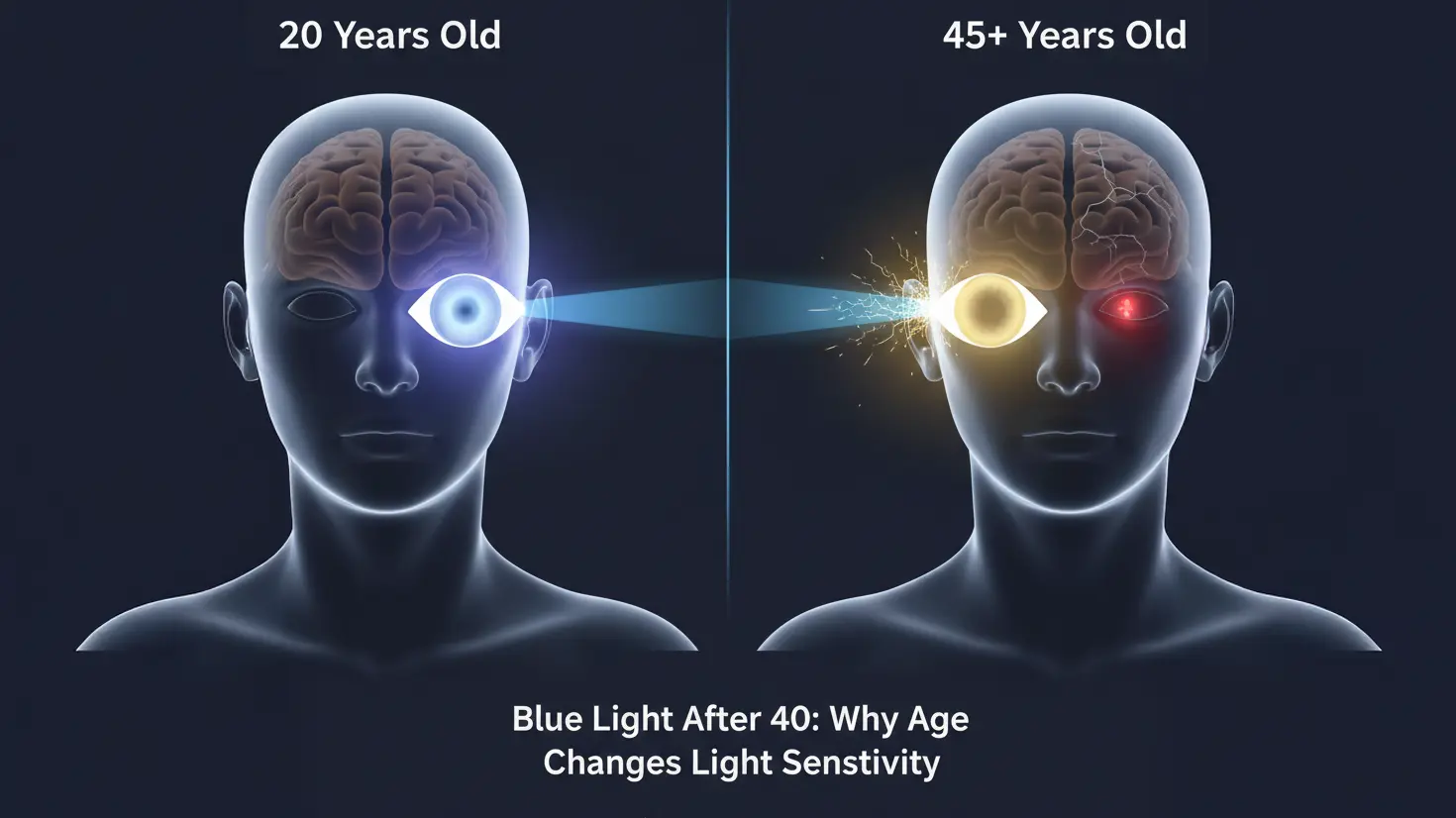
- Ocular Changes: The lens of the eye naturally yellows and thickens, changing how light is filtered.
- Circadian Weakening: The “master clock” in the brain becomes less resilient to light disruption as we age.
- Melatonin Reduction: Natural melatonin production peaks in youth and declines steadily after 40.
- Increased Recovery Time: It takes the aging brain longer to “reset” its internal clock after late-night screen use.
Quick Answer: Why does age change our reaction to blue light?
As we cross the age of 40, the eye’s lens undergoes structural changes, becoming more prone to scattering light, which increases glare. Simultaneously, the brain’s circadian rhythm becomes more “brittle.” While younger eyes can often “bounce back” from midnight scrolling, the aging brain has a diminished capacity to produce melatonin, making blue light exposure significantly more disruptive to sleep quality and next-day alertness.
The Science Behind This: The Aging Eye and Brain
Biology changes the way we perceive and process the world. After 40, light sensitivity is no longer just about vision—it’s about metabolic and hormonal regulation.
1. The Yellowing Lens
Throughout our lives, the crystalline lens of the eye gradually yellows. This is actually a defensive mechanism to protect the retina, as the yellow tint acts as a natural blue light filter. However, research in Investigative Ophthalmology & Visual Science indicates that this thickening also causes light to scatter more easily. This results in increased sensitivity to glare from high-intensity LEDs and smartphone screens (Hammond et al., 2012).
2. Diminished Melatonin Amplitude
The pineal gland’s ability to produce melatonin—the “hormone of darkness”—diminishes with age. A study published in the Journal of Clinical Endocrinology & Metabolism highlights that by age 50, the “amplitude” of melatonin production is significantly lower than in our 20s. Consequently, even a small amount of blue light at night can suppress what little melatonin remains, making sleep onset much harder (Duffy et al., 2015).+1
3. The SCN “Brittleness”
The suprachiasmatic nucleus (SCN), or the brain’s master clock, loses some of its precision as we age. In our 20s, the SCN is robust and can ignore minor disruptions. After 40, the SCN is more easily “misaligned” by external cues (like blue light), leading to earlier wake times and fragmented sleep cycles.
What This Means for You
If you’ve noticed that you can no longer stay up until 1 AM on your iPad without feeling “wrecked” the next day, it isn’t just your imagination. Your “biological buffer” has thinned. While a 20-year-old might experience a 30-minute sleep delay from blue light, a 45-year-old might find their entire sleep architecture shifted, leading to a 3 AM wake-up call and a morning of “brain fog.” Your brain simply needs more protection than it used to.
The Scroll-Hook: A Relatable Moment
You remember a time when you could work late under fluorescent lights, scroll through news at midnight, and still wake up feeling refreshed. Now, even fifteen minutes of reading a tablet in bed feels like it leaves a “glow” behind your eyes that won’t go away. You find yourself squinting at your phone, not because the text is small, but because the white background feels unnecessarily aggressive. This is your body telling you that its internal filter needs a manual upgrade.
Visual Logic: Adapting to Light Sensitivity
| Person Type | What to consider | Why it’s supported by evidence |
| The Active Professional | Shifting to “Dark Mode” on all devices permanently. | Reduces the total lux (intensity) hitting the retina, minimizing glare and eye strain. |
| The Evening Reader | Swapping tablets for E-ink devices (like a Paperwhite) or paper. | E-ink reflects ambient light rather than projecting blue light directly into the eye. |
| The Night Owl | Using “Warm” lighting (2700K or lower) in the home after 7 PM. | Lower color temperatures are less likely to trigger the “daytime” signal in the SCN. |
Simple Action Plan: The 40+ Light Protocol
- The “Amber Hour”: 60 minutes before bed, turn off all overhead “cool white” LEDs and use only warm lamps.
- Screen Distance: Keep devices at least 15–20 inches away. The intensity of light decreases exponentially with distance.
- Physical Protection: If you must use screens, use high-quality blue light filtering software (like f.lux) set to the “incandescent” or “candle” preset.
If you’re busy: The “Dark Mode” Default
Go into your phone and computer settings and schedule “Dark Mode” to turn on at sunset. It’s an automated way to reduce the impact on your retina without needing to remember a routine.
If you’re serious: The Lighting Audit
Replace the lightbulbs in your bedroom and bathroom with “Warm White” or “Amber” bulbs. Avoiding the blast of blue light from a bathroom vanity mirror during your nighttime routine is a game-changer for melatonin.
If you’re a beginner: The Morning Anchor
Spend 15 minutes outdoors in the morning sun. This strengthens your circadian signal, making your brain more resilient to the inevitable light disruptions later in the evening.
Pros & Cons of Light Management
Pros:
- Deeper Sleep: More consistent REM and Deep Sleep cycles.
- Reduced Eye Strain: Less “dry eye” and digital fatigue.
- Hormonal Balance: Supports natural cortisol and melatonin rhythms.
Cons:
- Initial Adjustment: Warm lighting can feel “dim” or “yellow” at first.
- Device Limitations: Some apps don’t look as intended in Dark Mode.
- Social Settings: You can’t always control the lighting in restaurants or friends’ homes.
FAQ
Are my headaches related to blue light?
Quite possibly. After 40, the increased glare from the yellowing lens can cause “digital eye strain” (asthenopia), which often manifests as a tension headache behind the eyes.
Should I wear blue light glasses all day?
Usually, no. You actually need blue light during the day to stay alert and regulate your mood. The goal is to limit it specifically in the 2–3 hours before sleep.
Final Takeaway
After age 40, changes in the eye’s lens and a natural decline in melatonin production make us more vulnerable to blue light disruption. While younger brains can often tolerate late-night screen use, older brains require more intentional light management to maintain sleep architecture. By adjusting device settings, using warm environmental lighting, and respecting the “Amber Hour,” you can protect your metabolic health and sleep quality for years to come.
References
- Duffy, J. F., et al. (2015). Effect of age on the melatonin rhythm and its relationship to sleep. The Journal of Clinical Endocrinology & Metabolism. https://doi.org/10.1210/jc.2014-2525
- Hammond, B. R., et al. (2012). The effects of blue light on the aging eye. Investigative Ophthalmology & Visual Science. https://doi.org/10.1167/iovs.12-9854
- Turner, P. L., & Mainster, M. A. (2008). Circadian photoreception: ageing and the eye’s important role in systemic health. British Journal of Ophthalmology. https://doi.org/10.1136/bjo.2008.141747