
Vital Summary
- Natural Hormone Power: GLP-1 is a hormone produced in your gut that tells your brain you are full.
- Brain-Gut Connection: It slows down stomach emptying, helping you feel satisfied for longer after eating.
- Blood Sugar Balance: It triggers insulin release only when needed, keeping energy levels stable.
- Quietens “Food Noise”: By signaling the brain’s reward center, it reduces constant cravings and intrusive thoughts about food.
Quick Answer: What is GLP-1 and how does it help?
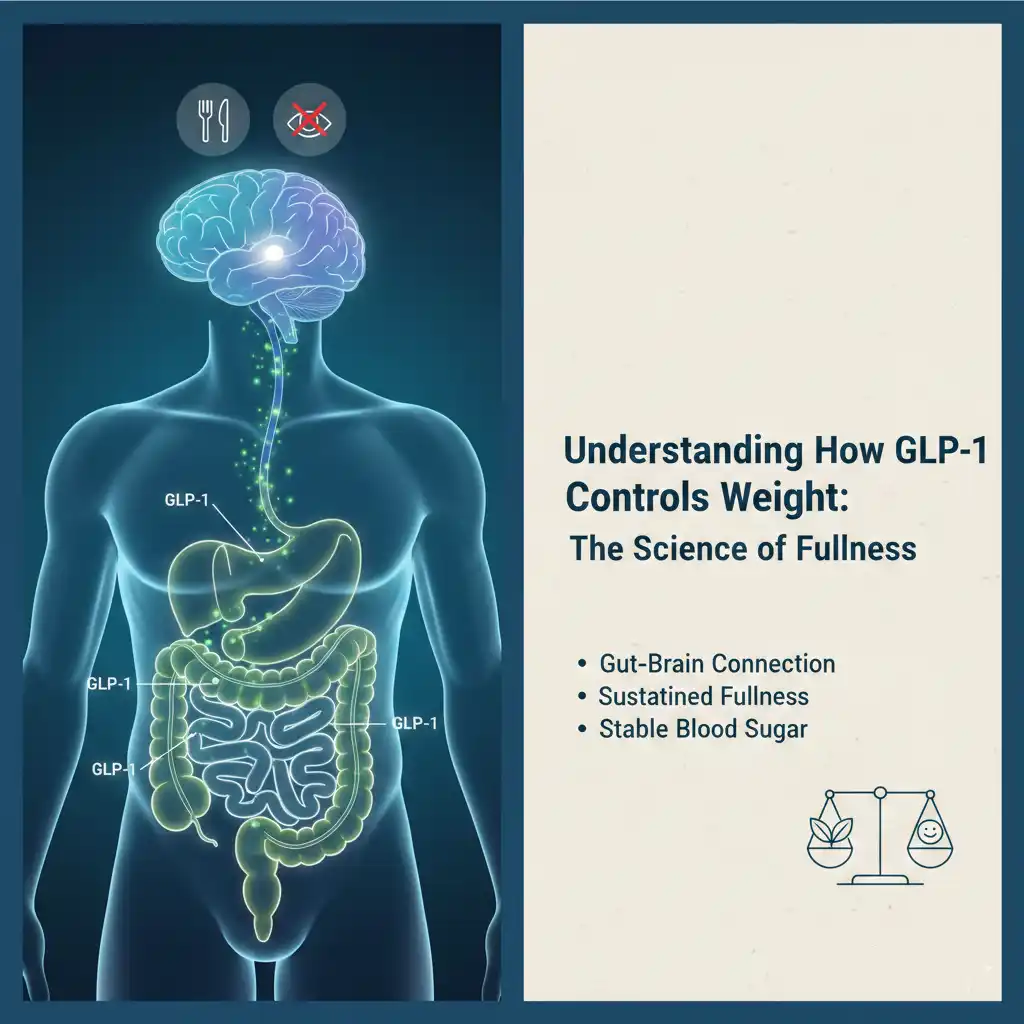
GLP-1 (Glucagon-like peptide-1) is a metabolic hormone that acts as a chemical messenger between the digestive system and the brain. It regulates weight by slowing digestion and signaling the hypothalamus to decrease appetite. Effectively, it lowers the body’s “set point” for hunger, making it easier to maintain a calorie deficit without the intense physical distress of starvation signals.
The Science Behind This: Your Body’s Internal Thermostat
To understand weight control, we must look beyond willpower and toward biology. GLP-1 is an incretin hormone, primarily secreted by the “L-cells” in your distal small intestine and colon in response to food intake.
1. The Gastric Brake
When you eat, GLP-1 acts as a “gastric brake.” It slows down gastric emptying—the speed at which food leaves your stomach and enters the small intestine. Research published in Nature Reviews Endocrinology confirms that this delay provides a physical sensation of fullness that lasts significantly longer than usual (Holst, 2021).
2. The Hypothalamus Signal
The hormone travels through the bloodstream or signals via the vagus nerve to the hypothalamus, the brain’s command center for energy balance. Here, it stimulates neurons that suppress appetite (POMC neurons) and inhibits those that increase it.
3. Insulin Sensitivity
Unlike some hormones that can cause crashes, GLP-1 is glucose-dependent. It tells the pancreas to release insulin—the hormone that moves sugar into cells—only when blood sugar is high. According to the Journal of Clinical Investigation, this prevents the dramatic spikes and dips in blood sugar that often lead to “hangry” episodes and overeating (Müller et al., 2019).
What This Means for You
If you have ever felt like you are fighting a losing battle with hunger, it isn’t a character flaw. For many, the natural GLP-1 response may be less sensitive or shorter-lived. This results in “food noise”—that persistent, internal chatter that reminds you the cookies are in the cupboard even when you aren’t physically hungry.
When GLP-1 levels are optimal, that chatter goes quiet. You don’t just “resist” the food; you simply find yourself thinking about it less. It shifts weight management from a mental struggle of restriction to a biological state of neutrality.
The Scroll-Hook: A Relatable Moment
You’ve likely finished a large, nutritious dinner, only to find yourself standing in front of the refrigerator twenty minutes later, searching for “something else.” You aren’t hungry, yet your brain is demanding a hit of energy or flavor. This disconnect—where the stomach is full but the brain is still searching—is exactly where the GLP-1 mechanism usually steps in to close the gap. When it works, that “search” never even begins.
Visual Logic: Understanding the GLP-1 Approach
| Person Type | What to consider | Why it’s supported by evidence |
| The Busy Professional | Focusing on protein and fiber to trigger natural GLP-1 release. | Fiber stays in the lower gut longer, stimulating L-cells to produce natural hormones (Hira et al., 2021). |
| The Serious Optimizer | Discussing medical GLP-1 agonists with a doctor for metabolic health. | Synthetic GLP-1 lasts hours or days, whereas natural GLP-1 degrades in minutes (Drucker, 2018). |
| The Beginner | Slowing down eating speed to allow the gut time to signal the brain. | The hormonal “fullness” signal takes approximately 15–20 minutes to reach peak efficacy. |
Simple Action Plan: Supporting Your Metabolic Signals
- Prioritize Fermentable Fibers: Foods like beans, oats, and artichokes reach the lower intestine where GLP-1 producing cells live.
- Sequence Your Meals: Eat your protein and vegetables before carbohydrates to maximize the incretin effect.
- Manage Sleep: Lack of sleep increases ghrelin (the hunger hormone), which can overpower the “fullness” signals of GLP-1.
If you’re busy: The 10% Rule
Focus exclusively on one high-fiber food at breakfast. This sets a better hormonal tone for the rest of the day with zero extra time spent.
If you’re serious: The Scientific Deep Dive
Track your “satiety window.” Note how long you feel full after different meals. You will likely find that meals high in healthy fats and fiber create a much stronger GLP-1 “afterglow” than simple starches.
If you’re a beginner: The Mindful Pause
Halfway through your meal, stop for two minutes. This gives your gut hormones time to start the journey to your brain before you decide if you need a second helping.
Pros & Cons of GLP-1 Focused Weight Management
Pros:
- Sustainability: Focuses on biology rather than just “trying harder.”
- Blood Sugar Health: Provides significant benefits for cardiovascular and metabolic stability.
- Reduced Stress: Decreases the mental load of constant calorie counting by reducing hunger at the source.
Cons:
- Gastrointestinal Sensitivity: Because it slows the stomach, some people experience nausea or bloating.
- Muscle Loss: If weight is lost too quickly without strength training, muscle mass can decrease alongside fat.
- Individual Variation: Natural GLP-1 production varies greatly based on genetics and gut microbiome health.
FAQ
Can I increase GLP-1 naturally?
Yes. While not as potent as medication, eating protein and viscous fibers (like glucomannan or beta-glucans) stimulates the gut’s L-cells to release more natural GLP-1.
Does GLP-1 only work for weight?
No. It also plays a role in heart health, kidney function, and even neuroprotection, as researchers are finding GLP-1 receptors throughout the body.
[Related: What is GLP-1]
Final Takeaway
GLP-1 is a vital metabolic hormone that regulates weight by slowing digestion and signaling fullness to the brain. By bridging the gap between the gut and the hypothalamus, it helps stabilize blood sugar and quietens the mental urge to overeat. Whether managed through nutrition, lifestyle, or medical guidance, supporting this pathway is a science-backed way to achieve sustainable weight control.
References
- Drucker, D. J. (2018). Mechanisms of Action and Therapeutic Application of Glucagon-like Peptide-1. Cell Metabolism. https://doi.org/10.1016/j.cmet.2018.03.001
- Holst, J. J. (2021). The physiology of glucagon-like peptide 1. Nature Reviews Endocrinology. https://doi.org/10.1038/s41574-021-00483-w
- Müller, T. D., et al. (2019). Glucagon-like peptide 1 (GLP-1). Molecular Metabolism. https://doi.org/10.1016/j.molmet.2019.09.010
- Hira, T., et al. (2021). Dietary factors modulates colonic GLP-1 secretion. Journal of Clinical Biochemistry and Nutrition. https://doi.org/10.3164/jcbn.20-101