Vital Summary
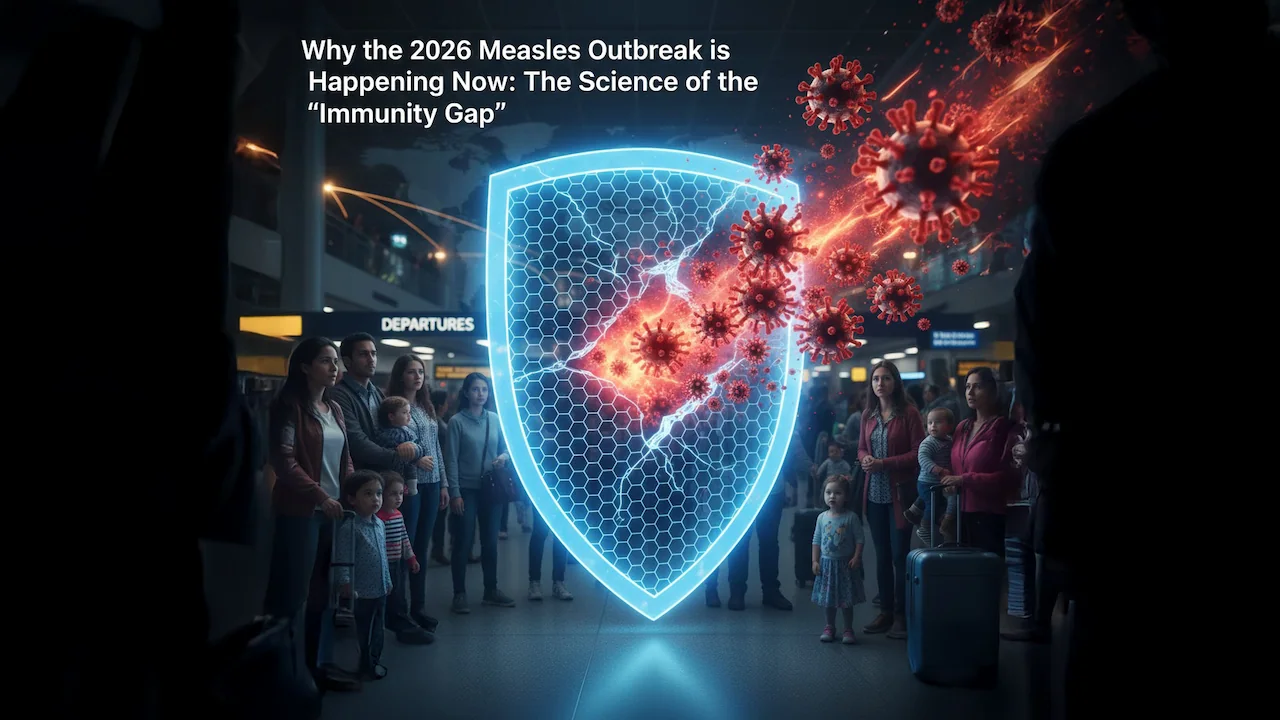
- The Herd Threshold: Measles requires 95% community vaccination to stop spreading; many areas have now dipped below 90%.
- Highly Contagious: One person can infect up to 18 others, making it six times more transmissible than COVID-19.
- Immune Amnesia: The virus can “reset” the body’s immune memory, leaving children vulnerable to other illnesses for years.
- Global Movement: Post-pandemic travel has reunited the virus with communities that have significant “immunity gaps.”
Quick Answer
The 2026 measles resurgence is driven by a “perfect storm” of falling vaccination rates and high global mobility. Public health data shows that routine childhood immunization levels have dropped below the 95% “herd immunity” threshold needed to keep this airborne virus contained. Because measles is exceptionally contagious, even small pockets of unvaccinated individuals allow the virus to establish a foothold and spread rapidly.
The Science Behind This
To understand why 2026 is seeing the highest case counts in over 30 years, we have to look at how measles interacts with a population. Unlike many other viruses, measles is an “all-or-nothing” pathogen in terms of community defense.
1. The R0 Factor (The Contagion Math) In epidemiology, R0 (pronounced R-naught) represents how many people one infected person will likely pass a virus to in a susceptible group. For the seasonal flu, R0 is usually around 1 to 2. For the 2026 measles strain, scientists at institutions like Stanford Medicine and the CDC note an R0 between 12 and 18. Because the math is so aggressive, even a 5% drop in local vaccination rates can lead to an exponential spike in cases.
2. The Concept of “Immune Amnesia” A critical reason health experts are concerned is a phenomenon called immune amnesia. Research published by the American Society for Microbiology shows that the measles virus doesn’t just make you sick; it actively destroys the “memory” cells in your immune system.
“Measles can eliminate 20% to 70% of a person’s preexisting antibodies,” effectively resetting their protection against other diseases like the flu or strep throat.
3. The 12-Month Elimination Rule The World Health Organization (WHO) and PAHO monitor “elimination status.” For a country to be considered measles-free, it must have no continuous transmission for 12 months. With 2026 seeing a 25% week-over-week increase in February, the U.S. and Mexico are currently at risk of losing the “eliminated” status they held for decades, as transmission has now persisted in several states since early 2025.
What This Means for You
In real life, this science manifests as a heightened “community alert” level. If you live in one of the 24 jurisdictions currently reporting cases—such as South Carolina, Arizona, or Utah—the risk of “passive exposure” (being in a room an hour after an infected person has left) is higher than it has been since the early 1990s.
Scroll-Hook: That “Wait, Did I?” Moment
You’re standing in a crowded grocery store or a busy airport terminal, and someone nearby has a persistent, barky cough. Normally, you wouldn’t give it a second thought. But then you remember the news segment from this morning about the “red-eye” symptoms. You find yourself wondering, Am I actually protected? Did I get that second booster in college? It’s a quiet, nagging weight of uncertainty that many are feeling for the first time in a generation.
Comparison Table: Navigating the Outbreak
| Person Type | What to consider | Why it’s supported by evidence |
| Busy Professional | Check digital health records for 2 doses of MMR. | Two doses are 97% effective; one dose is only 93%—a 4% gap that matters during outbreaks. |
| Serious/At-Risk | Discuss “titer testing” with a doctor if records are lost. | Blood tests can confirm if you still have active antibodies from childhood shots. |
| Beginner/Parent | Stick to the CDC schedule (12-15 months, then 4-6 years). | Early vaccination protects children before they enter social environments like daycare. |
Export to Sheets
Simple Action Plan
- Verify: Log into your healthcare portal to ensure you have two documented doses of the MMR (Measles, Mumps, Rubella) vaccine.
- Monitor: If you develop a high fever and “the three Cs” (Cough, Coryza/runny nose, Conjunctivitis), call your doctor before going to the clinic so they can prevent exposure to others.
- Prepare: If you are traveling to highly affected regions (currently South Carolina or Canada), ensure your family is fully immunized at least two weeks before departure.
- If you’re busy: Just find your vaccine card. Knowing your status is 90% of the battle.
- If you’re serious: Schedule a titer test to confirm your immunity if you were born between 1957 and 1989.
- If you’re a beginner: Read the CDC’s “Measles Fact Sheet” to learn how to distinguish a measles rash from common heat rashes.
Pros & Cons of Current Mitigation
Pros:
- The MMR vaccine is one of the most studied and safe medical interventions in history.
- High efficacy: Unlike the flu shot, the MMR provides nearly lifelong protection for most people.
Cons:
- The Incubation Gap: You can be contagious for 4 days before the rash appears, making it hard to stop the initial spread.
- Vulnerable Populations: Infants under 12 months cannot yet be vaccinated, relying entirely on the “herd” around them for protection.
FAQ
Can I get measles if I was vaccinated? It is extremely rare. About 3 out of 100 people who receive two doses will still get measles if exposed, but their symptoms are usually much milder and they are less likely to spread it.
Why is the virus staying in the air so long? Measles is an aerosolized virus. It is so light that it can hang in the air for up to two hours after an infected person has coughed or sneezed in a room.
Final Takeaway
The 2026 measles outbreak is a result of eroding community immunity combined with the virus’s natural ability to spread through the air with unmatched efficiency. While the resurgence is concerning, it is manageable through verified vaccination (two doses of MMR) and early symptom recognition. Protecting yourself not only guards your own health but helps close the “immunity gap” for those who cannot be vaccinated, such as infants and the immunocompromised.