
Vital Summary
- The “Silent” Shift: In 2026, stress has shifted from occasional “shocks” to a constant, low-level background noise that keeps the body in a permanent state of high alert.
- Biological Resistance: Chronic exposure to cortisol—the body’s stress hormone—is leading to “Glucocorticoid Receptor Resistance,” meaning your body loses its ability to turn off inflammation.
- Cellular Aging: Prolonged stress is now scientifically linked to accelerated telomere shortening, effectively aging your cells by up to a decade faster than your chronological age.
- Practical Defense: Shifting the body from “Fight or Flight” to “Rest and Digest” requires small, consistent nervous system “resets” rather than major life overhauls.
The Science Behind This
In 2026, clinical research has moved beyond simply measuring “high” or “low” stress. We now understand that the primary danger isn’t the presence of stress itself, but its persistence.
Under normal conditions, the hypothalamic-pituitary-adrenal (HPA) axis releases cortisol to help you handle a challenge. Once the threat passes, the system shuts down. However, recent data from the American Psychological Association (2025/2026) indicates that 62% of U.S. adults now cite “societal division” and 57% cite “AI integration” as constant stressors. This means the alarm never turns off.
The most critical discovery in recent years is Glucocorticoid Receptor Resistance (GCR). When the body is flooded with cortisol for months or years, your immune cells become “deaf” to its signal. Since cortisol’s job is to suppress inflammation, GCR allows inflammation to run wild, contributing to the rise in autoimmune disorders, cardiovascular disease, and metabolic syndrome seen across the U.S. in early 2026.
Key Research Indicators:
- Biological Aging: A study from the University of Florida (2025) suggests that chronic stress can reduce life expectancy by an average of 2.8 years and significantly accelerate cellular aging.
- Cognitive Decline: Research published in PMC (2025) shows that long-term occupational stress leads to measurable atrophy in the prefrontal cortex—the part of the brain responsible for focus and decision-making.
- Immune Dysfunction: Findings in PNAS highlight that GCR (Glucocorticoid Receptor Resistance) is a better predictor of illness than actual cortisol levels, explaining why “stressed” people catch more colds and recover slower.
What This Means for You
For the average American in 2026, this “silent” crisis often doesn’t look like a panic attack. It looks like “functional exhaustion.”
You might feel “stuck” in a state where you are tired but unable to sleep deeply, or where minor inconveniences trigger a disproportionate level of irritation. This is the Nervous System Debt that accumulates when your body spends too much time in the sympathetic (active) state and not enough in the parasympathetic (recovery) state.
Because the stress is chronic rather than acute, we often normalize symptoms like digestive issues, brain fog, and muscle tension, labeling them as “just getting older.” In reality, these are often early warning signals that the HPA axis is struggling to regulate your internal environment.
Comparison Table: Stress Management Strategies
| Person Type | What to consider | Why it’s supported by evidence |
| The Busy Professional | Nervous System “Micro-Breaks” (1–2 minutes) | Physiological sighs (double inhale, long exhale) instantly trigger the vagus nerve to lower heart rate. |
| The Serious Optimizer | HRV (Heart Rate Variability) Tracking | HRV is a direct metric of autonomic nervous system balance; higher variability indicates better stress resilience. |
| The Beginner | Circadian Sunlight Exposure | Morning sunlight helps regulate the natural cortisol peak, preventing “flat” or “inverted” cortisol rhythms later in the day. |
Simple Action Plan (1–2–3)
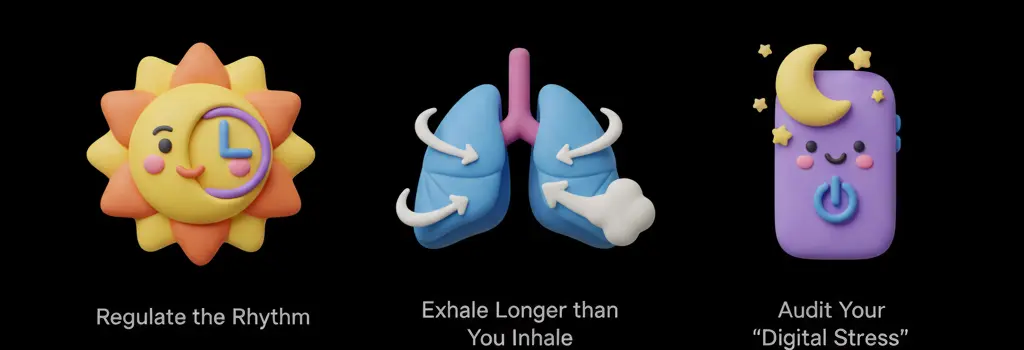
- Regulate the Rhythm: Expose your eyes to natural light within 20 minutes of waking to set your biological clock.
- Exhale Longer than You Inhale: When feeling overwhelmed, perform three “Physiological Sighs”—inhale deeply through the nose, add a second short “sip” of air at the top, and exhale slowly through the mouth.
- Audit Your “Digital Stress”: Set a “Digital Sunset” 60 minutes before bed to allow your brain to exit the “High Alert” state created by scrolling.
If you’re busy:
Focus exclusively on the Physiological Sigh. Do it three times before every meal. It takes 30 seconds and communicates “safety” to your brain, improving digestion and lowering cortisol.
If you’re serious:
Incorporate Zone 2 Cardio (steady-state exercise where you can still hold a conversation) for 150 minutes per week. This has been shown to improve “Biological Resilience”—the body’s ability to recover from a stress spike.
If you’re a beginner:
Start with a 3-minute “Brain Dump” journal before bed. Writing down the things you are worried about “offloads” them from your working memory, reducing the cognitive load that keeps your nervous system on guard at night.
Pros & Cons
Pros:
- Stress management improves immune function and reduces long-term disease risk.
- Better regulation leads to clearer thinking and improved relationship stability.
- Low-cost interventions (breathing, light) are highly effective.
Cons:
- Requires consistency; one “relaxing weekend” cannot undo months of chronic activation.
- Addressing stress often requires making difficult boundary choices (e.g., work hours or news consumption).
- Individual responses vary based on genetics and past trauma.
References
- American Psychological Association. (2025). Stress in America 2025: A crisis of connection. https://www.apa.org/pubs/reports/stress-in-america/2025
- University of Florida. (2025). Stress and Life Expectancy: How Does One Impact the Other? https://online.aging.ufl.edu/2025/01/22/stress-and-life-expectancy-how-does-one-impact-the-other/
- Yale Medicine. (2026). Chronic Stress Fact Sheet. https://www.yalemedicine.org/conditions/stress-disorder
- National Institutes of Health (PMC). (2025). The effects of chronic stress on health: New insights into molecular mechanisms. https://pmc.ncbi.nlm.nih.gov/articles/PMC5137920/